
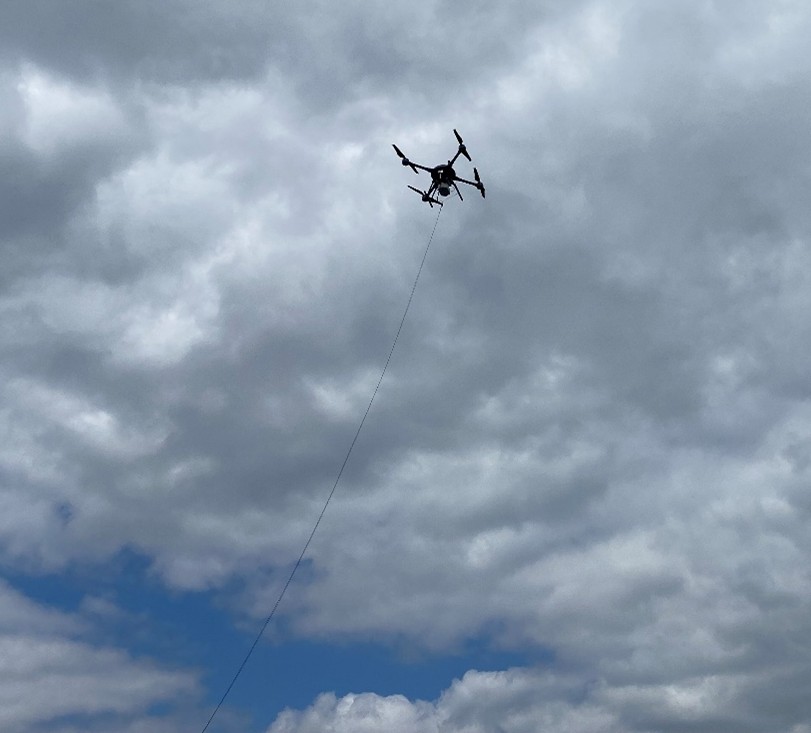
What is a Variable Height Antenna (VHA)?
A variable height antenna is a communication or signal relay system that can be dynamically positioned at different altitudes to optimize performance. Traditionally, antennas are fixed to ground-based structures, limiting their line-of-sight and coverage. By integrating the antenna with a tethered drone, it can be elevated to various heights — ranging from tens to hundreds of feet — depending on mission requirements, the terrain, and environmental conditions. This flexibility allows for enhanced signal propagation, reduced interference, and improved connectivity in challenging and remote areas.

Benefits of Using a Variable Height Antenna on a Tethered Drone
Deploying a variable height antenna via a tethered drone offers several key advantages over traditional fixed or mobile antenna systems:
- Optimized Signal Coverage — Elevating the antenna improves line-of-sight, reduces obstructions, and extends communication range, which is critical in urban, mountain, and forest environments.
- Rapid Deployment — Tethered drones can be powered and launched within minutes, making them ideal for emergency response, temporary events, and tactical operations.
- Altitude Flexibility — Operators can adjust the antenna height in real time, adapting to changing conditions or mission needs to ensure optimal performance.
- Persistent Operation — Unlike free-flying drones, tethered systems can operate continuously for hours or even days thanks to ground-based power and data connections.
- Secure and Stable Platform — The tether provides physical stability and a secure data/power link, reducing the risk of signal loss or drone drift.
- Reduced RF Interference — By elevating the antenna above ground clutter and competing signals, the system can achieve cleaner transmission and reception.
How Tethered Drones Increase the Range
To calculate an antenna’s theoretical line-of-sight communication range, use the formula:
Range (miles) = 1.33 × (√H₁ + √H₂)², where H₁ and H₂ are the heights of the two antennas in feet, accounting for the Earth’s curvature. Higher altitudes significantly increase range because they extend the line of sight — doubling antenna height increases range by a factor of √2 (approximately 1.41). Real-world range is reduced by obstructions, atmospheric conditions, transmitter power, receiver sensitivity, and cable losses.
| Antenna Height (m) | Line-of-Sight (km) |
|---|---|
| 1 | 3.57 |
| 20 | 15.97 |
| 40 | 22.58 |
| 60 | 27.65 |
| 80 | 31.93 |
| 100 | 35.70 |

Unmanned Aerial Systems: Choosing Radio Relays
As Unmanned Aerial Systems (UAS) become increasingly vital to modern operations, the demand for emergency response, infrastructure monitoring, and defense communications depends heavily on reliable, secure, and scalable connectivity. At Zenith Aerotech, we recognize that communication is the backbone of every successful UAS deployment — selecting the right radio relay system is more than a technical choice, it’s a strategic one.
The Role of Radio Relays in UAS Operations
Radio relays serve as airborne communication nodes, extending the reach of ground-based networks and enabling real-time data exchange between unmanned platforms and command centers. In environments where terrain, distance, or infrastructure limitations obstruct line-of-sight communication, radio relays provide a critical link, ensuring uninterrupted telemetry, video transmission, and command-and-control capabilities. Zenith Aerotech’s tethered systems are suited for operating at altitudes up to 400 feet, powered continuously via ground-based tethers, offering persistent, elevated communication coverage for days at a time — ideal for mobile ad hoc networking (MANET), military operations, disaster recovery, border security, and remote industrial operations.

Key Considerations When Choosing a Radio Relay
- Frequency Band Compatibility — relay systems must align with mission-specific frequency requirements (UHF, VHF, S, L, C band) and regulatory compliance.
- Encryption and Data Security — Zenith Aerotech platforms support advanced encryption protocols, including AES-256, and can separate security levels on the same platform using VLANs.
- Payload Efficiency and Power Management — Zenith Aerotech supports payloads up to 20 lbs. and payload power up to 1 kW.
- Network Scalability and Mesh Integration — modern relay systems support dynamic routing and mesh networking for resilient, self-healing communication.
- Environmental Durability — Zenith Aerotech’s platforms are engineered to perform reliably from extreme temperatures to maritime environments.
Why Choose Zenith Aerotech’s Variable Height Antenna Solution?
- Precision Altitude Control — automated winch systems allow smooth, accurate height adjustments even in challenging weather.
- Payload Versatility — supports LTE, 5G, mesh networking, and specialized RF equipment.
- Rugged Reliability — tested to perform in harsh environments, from deserts to disaster zones.
- Integrated Power and Data — a continuous supply of high-speed data and power removes the need for battery swaps.
- Custom Engineering Support — solutions tailored to specific operational needs.
- RF over Fiber — radio systems can remain on the ground while the tethered platform carries only the antenna aloft, with data carried over fiber.

Proven Capabilities in the Field
Zenith Aerotech has successfully integrated advanced radio relays into our tethered platforms, including Persistent Systems, TrellisWare, Silvus Technologies, Triad RF, and Ultra, supporting force protection, early threat warning, and disaster recovery missions. The Quad-8 can carry up to 20 lbs. of equipment while simultaneously enabling threat detection surveillance and secure communications, with intuitive control via Zenith QGC software.

Learn More
If you have questions about how Zenith Aerotech can support your mission with tethered drone solutions, please reach out to our team. We’re ready to help you elevate your operational advantage.